



Tel: +86-13392301066 Email: elaine@ohoryelectric.com

AI Intelligent Busway System

Molecular-Shield Solid Insulation Busway Integral Molded IP68 Partial Discharge 5pC 8kV AI Data Center GPU Rack

Product Description:

Product Overview

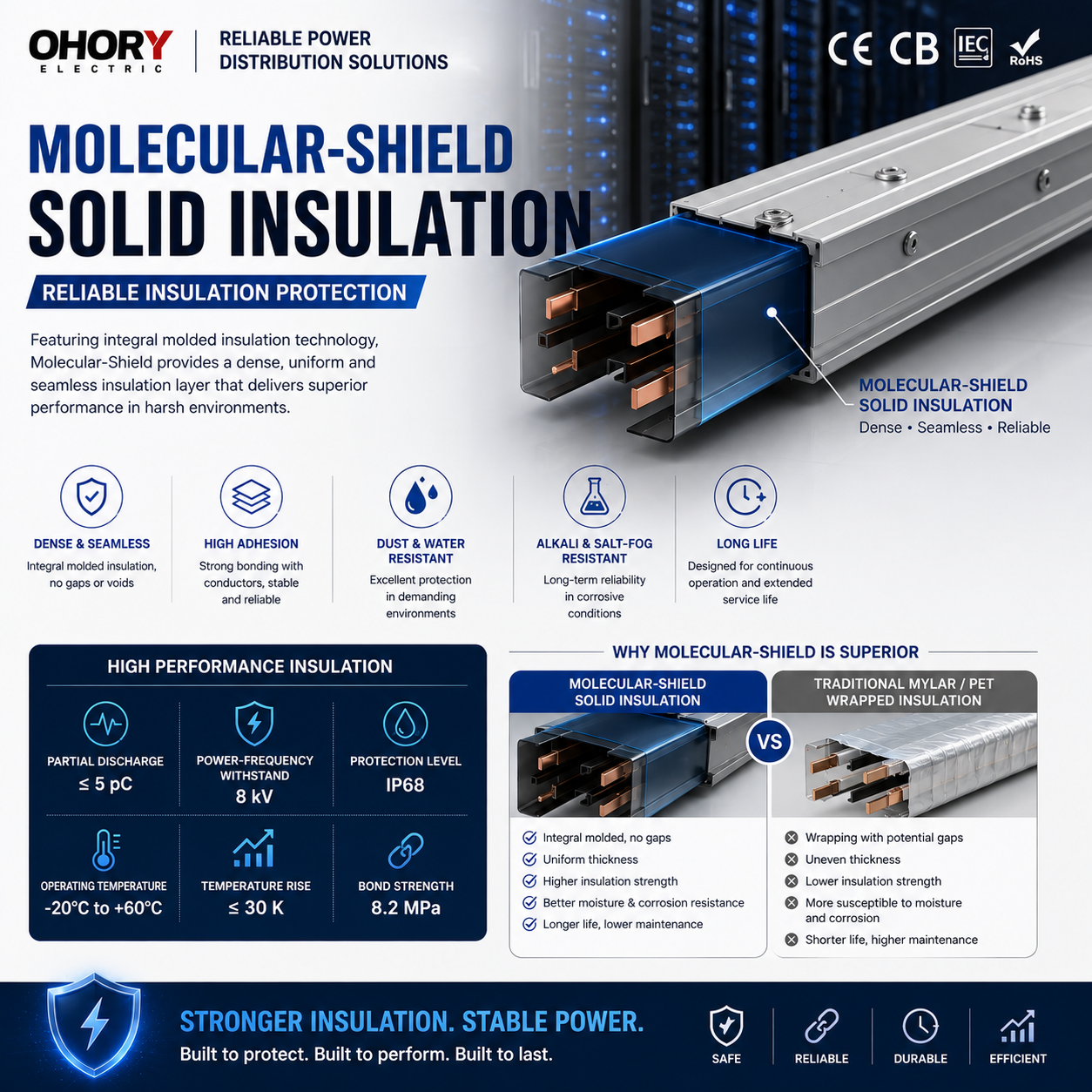
Molecular-Shield Solid Insulation is the proprietary integral-molded insulation system integrated into the AI+ Intelligent Busway, engineered specifically for the thermal, electrical, and environmental demands of AI data centers, GPU clusters, and 100kW-class high-density rack rows operating under continuous full-load conditions.

Unlike conventional Mylar / PET film wrapping — which relies on manual overlap, adhesive bonding, and edge sealing that can develop joints, moisture penetration paths, and localized weak points over time — Molecular-Shield forms a dense, seamless, continuous solid insulation layer directly on the conductor surface through integral molding. The result is an insulation structure with verifiable, repeatable, and scalable performance: partial discharge ≤5 pC, 8 kV power-frequency withstand, ≤30 K temperature rise under full load, 8.2 MPa insulation-to-conductor bond strength, and IP68 protection.

For AI data centers where busways must carry high current 24/7, support sustained thermal stress from 100kW-class rack loads, and operate reliably in humid or environmentally demanding conditions, Molecular-Shield upgrades insulation from a material protection layer to the structural reliability foundation of the entire intelligent busway system.

Key Features

FeatureDescription
Integral Molded Continuous CoverageInsulation layer is formed directly and continuously on the conductor surface — eliminating wrap joints, overlap seams, and edge gaps that conventional film wrapping leaves as potential electrical weak points
Partial Discharge ≤ 5 pCExtremely low partial discharge value confirms insulation integrity and continuity — reducing the risk of long-term insulation degradation under high-voltage stress
8 kV Power-Frequency Withstand (No Breakdown)Verified dielectric strength providing a substantial safety margin above operating voltage — confirmed through standardized withstand testing
Temperature Rise ≤ 30 K at Full LoadControlled thermal performance under continuous high-current operation supports 100kW-class rack environments and reduces heat accumulation risk
8.2 MPa Bond StrengthHigh insulation-to-conductor bond strength resists delamination, thermal cycling fatigue, and mechanical stress over the busway lifecycle
IP68 Protection RatingFull dust and water ingress protection — enabling deployment in humid data center environments, coastal facilities, and salt-fog exposed installations
Wide Operating Temperature: -20°C to +60°CReliable insulation performance across the full temperature range encountered in data center environments, including high-ambient-temperature dense rack zones
Environmental ResistanceIntegral sealed structure resists moisture penetration, dust ingress, alkali exposure, and salt-fog corrosion — addressing failure modes common at film wrapping edges and joints
Consistent Batch ProductionControlled molding process delivers more uniform insulation thickness and coverage than manual film wrapping — reducing quality variance across production batches
Adapts to Complex GeometriesIntegral molding conforms to conductor corners, joints, and transition sections where film wrapping typically creates uneven thickness, voids, or wrinkling

Technical Specifications

ParameterSpecificationParameterSpecification
Insulation TechnologyMolecular-Shield Solid Insulation (Integral Molded)vs. ConventionalMylar / PET Film Wrapping (Wrapped)
Partial Discharge≤ 5 pCPower-Freq Withstand8 kV (No Breakdown)
Temperature Rise≤ 30 K (Full Load)Bond Strength8.2 MPa
Protection GradeIP68Operating Temp-20°C to +60°C
CoverageDense, Seamless, ContinuousThickness ControlUniform — Process-Controlled
Moisture ResistanceIntegral Sealed — No Edge Penetration PathSalt-Fog ResistanceYes — Suitable for Coastal / Harsh Environments
Alkali ResistanceYesDust ResistanceIP68 — Full Dustproof
Heat DissipationContinuous Layer Improves Thermal Path UniformityBatch ConsistencyHigh — Less Dependence on Manual Technique
ApplicationAI Data Center Busway / GPU Cluster / 100kW-Class RackIntegrated InAI+ Intelligent Busway System

Applications

  • AI Data Centers — High-Density Rack Rows — Sustained full-load operation of 100kW-class GPU racks demands insulation that maintains integrity under continuous thermal and electrical stress — Molecular-Shield provides the reliability foundation
  • GPU Cluster Power Infrastructure — Dynamic load fluctuations from GPU training/inference workload cycles create thermal cycling stress; integral molded insulation resists delamination and degradation better than adhesive-bonded film wrapping
  • HPC Facilities — Long-duration continuous computation loads require insulation systems verified for sustained high-current, high-temperature performance
  • Humid & Coastal Data Centers — IP68-rated integral molded insulation eliminates the edge and joint moisture penetration paths that cause film-wrapped insulation failures in high-humidity or salt-fog environments
  • Colocation & Hyperscale Data Centers — Consistent batch insulation quality supports large-scale procurement and installation across multiple data center builds
  • Mission-Critical Facilities — Financial institutions, defense, and healthcare IT infrastructure requiring verified, traceable insulation performance with minimal long-term degradation risk
  • Industrial & Manufacturing Compute Hubs — Dusty, chemically active environments where IP68 and alkali-resistance protect against contamination-induced insulation failure
  • Edge Computing Deployments — Compact busway installations in space-constrained environments where insulation must adapt to complex geometries without voids or wrinkles
  • Telecom Base Station Power — Outdoor and semi-outdoor installations where moisture, dust, and temperature variation demand robust sealed insulation
  • Future High-Voltage Architecture — As AI data center power moves toward higher voltage directions, low partial discharge and high withstand voltage provide the insulation margin for architecture evolution


Inquiry: